
Who Is Junya Watanabe? The Designer Behind the Cult Fashion Label

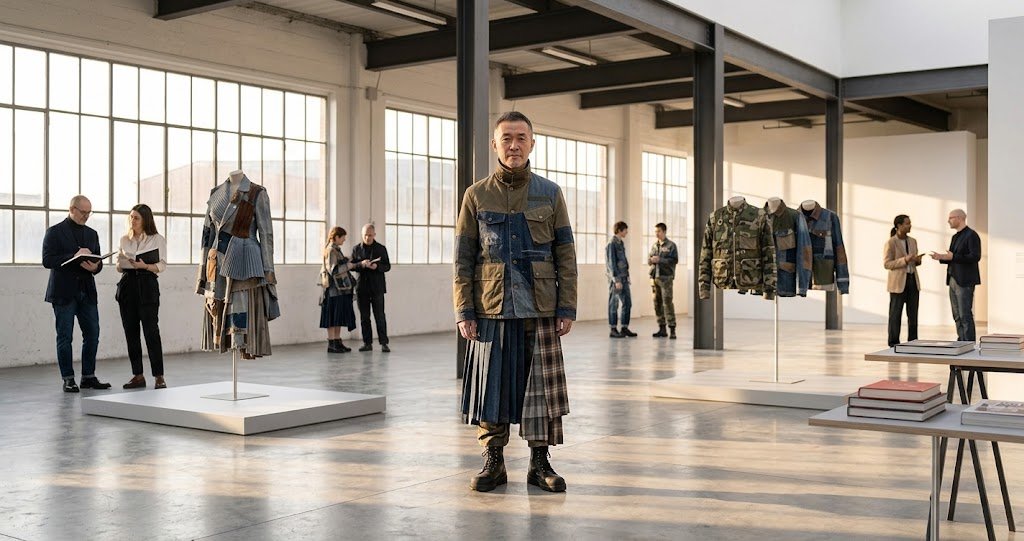
Who Is Junya Watanabe? The Designer Behind the Cult Fashion Label is a question that leads into one of fashion’s most technically inventive careers. Junya Watanabe is a Japanese designer born in Fukushima in 1961 who built his reputation through experimental pattern cutting, unusual textiles, reconstructed garments, and a remarkably sophisticated approach to collaboration.
Unlike designers who rely heavily on interviews to explain their work, Watanabe has generally allowed the clothes to communicate for him. He developed his namesake label within the Comme des Garçons universe, first presenting his own womenswear collection in Tokyo in 1992 and in Paris in 1993. His menswear line followed with its Spring/Summer 2001 Paris debut.
What makes Junya Watanabe especially important is the way he turns familiar clothing into something structurally new. A denim jacket, military coat, tailored suit, sneaker, or workwear garment can become the starting point for an entirely different design.
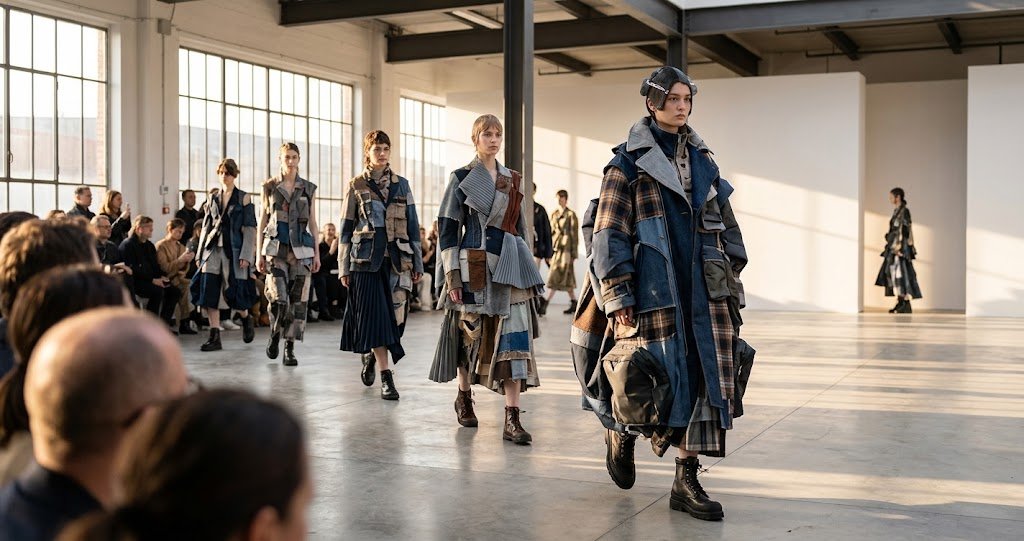
Alt text: Who Is Junya Watanabe The Designer Behind the Cult Fashion Label runway
Who Is Junya Watanabe?
Junya Watanabe is a Japanese fashion designer best known for his namesake label and his long relationship with Comme des Garçons.
He studied design at Bunka Fashion College in Tokyo and graduated in 1984. That same year, he joined Comme des Garçons, initially working as a patternmaker. In 1987, he became chief designer of the Comme des Garçons Tricot knitwear line. His early career therefore developed from the technical side of clothing construction rather than from celebrity-driven fashion culture.
That background helps explain an important characteristic of his work: construction comes first.
Watanabe is interested in what fabric can do, how a garment can be cut, and how an existing object can be reconstructed. His designs often look futuristic, but their starting points can be surprisingly ordinary.
The Fédération de la Haute Couture et de la Mode lists the Junya Watanabe house as founded in 1992, with Watanabe as its artistic director. It also records his Mainichi Fashion Grand Prix wins in 1993 and 1999.
How Did Junya Watanabe Start His Fashion Career?
Watanabe’s career began inside the highly influential creative environment of Comme des Garçons.
After graduating from Bunka Fashion College, he joined the company in 1984. His work as a patternmaker gave him an unusually practical understanding of garment construction. Rather than approaching clothing purely as illustration, he learned to think through seams, volume, fabric behavior, and proportion.
His promotion to chief designer of Tricot in 1987 was another important step. By the early 1990s, Rei Kawakubo had given him room to develop a label under his own name. Watanabe presented his first namesake womenswear collection in Tokyo in 1992 and showed in Paris the following year.
This progression is important because it explains why Junya Watanabe does not fit neatly into the category of either traditional luxury designer or purely conceptual artist.
He combines both.
His clothes can be intellectually ambitious while still being based on recognisable garments such as jackets, trousers, denim, military clothing, and workwear.
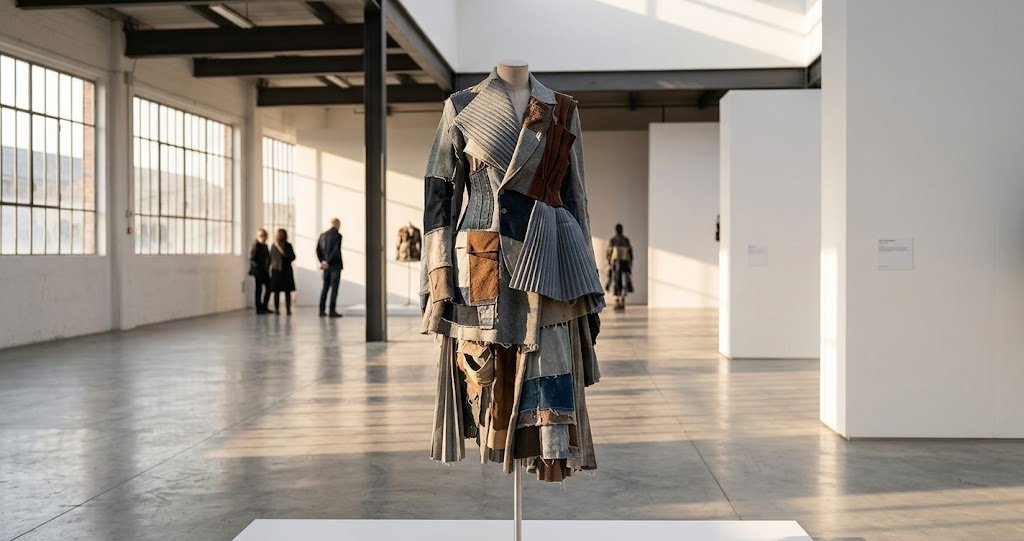
Alt text: Junya Watanabe experimental garment and technical fashion design
What Is Junya Watanabe Known For?
Junya Watanabe is known for technical experimentation, sculptural construction, reconstructed clothing, synthetic materials, patchwork, and collaborations with established brands.
One of the clearest examples is his Fall/Winter 2000–2001 work, often associated with “techno-couture.” The Metropolitan Museum of Art’s collection includes a Junya Watanabe ensemble from that season and describes its combination of newly developed fabrics, intricate construction, and experimental techniques.
Techno-Couture and Experimental Fabrics
Watanabe has frequently explored the relationship between technology and clothing.
Synthetic textiles can become architectural. Pleats can create volume. Layers can be manipulated to change the silhouette. Garments may contain functions or transformations that are not immediately visible from a distance.
This is why photographs do not always capture the full experience of his clothes. A Watanabe piece may look simple on a hanger but reveal its intelligence when worn, folded, opened, reversed, or adjusted.
Reconstructing Familiar Garments
Another defining characteristic is his treatment of established clothing.
Instead of inventing every garment from nothing, Watanabe often starts with something people already understand: a denim jacket, military coat, tailored jacket, sneaker, work shirt, or pair of trousers.
He then changes its proportions, materials, construction, or function.
That approach has become one of the strongest signatures of his design language.
Punk, Military and Workwear Influences
His collections have repeatedly explored punk, military clothing, British tailoring, denim, outdoor equipment, and utilitarian garments.
The result is often a tension between hard and soft, traditional and futuristic, practical and theatrical.
That tension is a useful key to understanding the label.
Why Is Junya Watanabe Associated With Comme des Garçons?
Junya Watanabe is closely associated with Comme des Garçons because his namesake label developed under that company’s umbrella and because Rei Kawakubo played an important role in his professional development.
However, Junya Watanabe is not simply a copy of Kawakubo.
The two designers share an interest in challenging conventional ideas about clothing, but Watanabe developed his own vocabulary through technical construction, fabric experimentation, and the transformation of existing garments.
His relative privacy also adds to the distinction. Watanabe rarely gives extensive interviews and has historically preferred to let his collections speak for themselves. Vogue has noted that his reluctance to explain his concepts contributes to the intrigue surrounding the label and its unusually devoted collectors.
This creates an unusual relationship between designer and audience: the less Watanabe explains, the more intensely collectors study the garments.
What Are Junya Watanabe’s Most Notable Collaborations?
Collaboration is central to understanding Junya Watanabe.
His partnerships have included names such as Levi’s, Converse, Nike, Carhartt, The North Face, Porter Yoshida, Brooks Brothers, Reebok, Tamiya, and others.
But these collaborations are more than simple logo partnerships.
Watanabe often treats another brand’s established product or material as a design framework.
His early menswear work provides a particularly clear example. Vogue reported that his first menswear collection in Paris used Levi’s denim as a foundation, incorporating text and reworking familiar denim forms.
That method became hugely influential because it demonstrated how a designer could preserve the identity of a familiar product while radically changing its meaning.
Why the Collaborations Matter
A typical fashion collaboration may simply place two brand identities together.
Watanabe’s best collaborations work differently:
- He identifies a recognisable object or garment.
- He preserves some of its original identity.
- He changes its construction, context, or function.
- The result feels connected to both brands but belongs to neither in a conventional way.
Original insight: This is one of the best ways to read a Junya Watanabe archive. Instead of asking only, “What brand is this collaboration with?”, ask, “What did Watanabe change about the original object?” That question reveals the design thinking behind many of his most interesting pieces.
Why Does Junya Watanabe Have a Cult Following?
The phrase “cult fashion label” is not just marketing language. Watanabe has developed an unusually committed collector culture.
Vogue documented the Junya Watanabe World collector community, where enthusiasts discussed rare runway pieces, traded garments, searched for older collections, and studied collaborations. The group included collectors interested in both womenswear and menswear, demonstrating how Watanabe’s design language can cross conventional gender boundaries.
Collectors are attracted to several things:
- Distinctive construction: Older pieces can reveal techniques that are difficult to replicate.
- Limited availability: Archival garments are often difficult to find.
- Collaboration history: Individual seasons can connect Watanabe to different specialist brands.
- Wearability: Many experimental designs remain practical enough for everyday use.
- Archive depth: Three decades of collections provide an enormous field for collectors to explore.
This combination gives the label an unusual longevity.
A collector may begin with one pair of jeans or a jacket and eventually become interested in a particular season, material, collaboration, or construction technique.
What Makes Junya Watanabe Different From Other Avant-Garde Designers?
The simplest answer is that Watanabe often makes experimentation functional.
Avant-garde fashion can sometimes prioritise visual impact over everyday usefulness. Watanabe frequently takes the opposite route: he starts with something recognisable and makes it strange without completely destroying its purpose.
That is particularly visible in his workwear and military-inspired designs.
A coat may retain pockets because pockets are useful. A jacket may remain recognisably a jacket. Denim still behaves like denim. But the proportions, layering, panels, fabrics, or construction can transform the object.
The Metropolitan Museum’s documentation of his Fall/Winter 2000–2001 ensemble is a good illustration of this broader philosophy: experimental techniques and technically sophisticated construction are combined with a wearable garment format.
In other words, Watanabe’s innovation is often hidden inside familiar clothing.
Junya Watanabe’s Influence on Modern Fashion
Watanabe’s influence extends beyond his own collections.
His collaborative approach helped demonstrate how established brands could become raw material for high-fashion experimentation. His menswear work with Levi’s is particularly significant because it showed how an iconic commercial product could be transformed without losing its recognisable identity. Vogue has described this approach as an early and influential example of the kind of cross-brand fashion collaboration that later became widespread.
His technical approach has also influenced the way fashion audiences think about garments.
Instead of evaluating clothing only by colour, logo, or silhouette, Watanabe encourages attention to:
- construction;
- fabric technology;
- functionality;
- transformation;
- historical references;
- and the relationship between an original garment and its reinterpretation.
That is one reason archival Junya Watanabe remains interesting long after a collection leaves the runway.
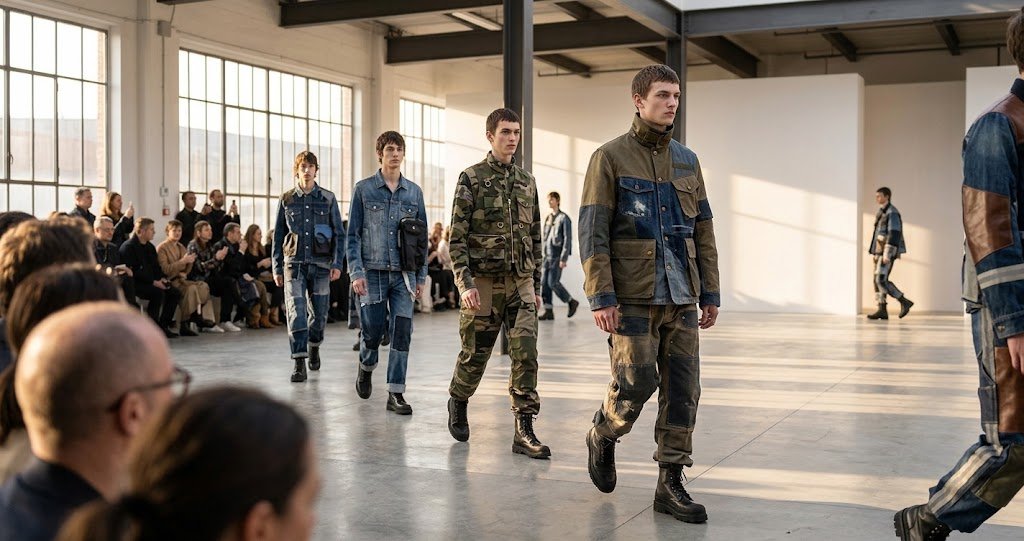
Alt text: Junya Watanabe cult fashion label menswear and reconstructed workwear
Is Junya Watanabe Still Relevant in 2026?
Yes. The strongest evidence is not simply resale interest or nostalgia; the house remains part of the Paris fashion system.
The Fédération de la Haute Couture et de la Mode currently lists Junya Watanabe collections, including Fall/Winter 2026–2027 womenswear, and identifies Watanabe as the house’s artistic director.
That continuing presence matters.
Many experimental designers become primarily historical references. Watanabe’s label, by contrast, continues to produce collections while maintaining a design language developed over decades.
For someone discovering the brand in 2026, the best approach is therefore not to start with hype.
Start with the clothes.
Look at the construction, identify the original garment being transformed, examine the materials, and then trace the collection or collaboration backward. That process makes the archive much easier to understand.
What Is the Legacy of Junya Watanabe?
Junya Watanabe’s legacy is built on an unusually powerful idea: innovation does not always require abandoning the familiar.
His career also demonstrates the importance of technical skill in fashion.
The path from Bunka Fashion College to patternmaking, Tricot, a namesake womenswear label, Paris runway collections, menswear, and decades of collaborations is a coherent story of craftsmanship evolving into authorship.
That may be the clearest answer to Who Is Junya Watanabe?
He is not simply the designer behind an avant-garde Japanese label. He is a designer who has spent decades investigating what happens when familiar clothing is rebuilt with unfamiliar ideas.
Final Thoughts
Junya Watanabe occupies a rare position in contemporary fashion. He is technically rigorous, commercially connected, deeply collaborative, and still fiercely individual.
His relationship with Comme des Garçons and Rei Kawakubo provided an important foundation, but his own work developed into a distinct design language built around experimentation, reconstruction, technology, utility, and collaboration.
For fashion newcomers, his work can initially look complicated. For collectors, that complexity is exactly the attraction.
The easiest way to understand Junya Watanabe is to look beyond the surface. Ask what the garment originally was, what Watanabe changed, why he changed it, and whether the final piece still functions.
Once you start asking those questions, the cult following makes considerably more sense.
Want to explore more influential designers and fashion houses?
FAQ: Junya Watanabe
Who is Junya Watanabe?
Junya Watanabe is a Japanese fashion designer born in Fukushima in 1961. He joined Comme des Garçons in 1984 and launched his namesake label in 1992. His work is known for experimental construction, technical fabrics, reconstructed garments, and collaborations.
Is Junya Watanabe part of Comme des Garçons?
Yes. His namesake label was developed under the Comme des Garçons umbrella, and Watanabe has maintained a long professional relationship with the company. His atelier has also been based at Comme des Garçons’ Tokyo headquarters.
What is Junya Watanabe famous for?
He is particularly famous for experimental pattern cutting, technical textiles, reconstructed clothing, patchwork, military and workwear influences, and collaborations with brands including Levi’s, Converse, Nike, Carhartt, The North Face, and others.
When did Junya Watanabe start his brand?
Watanabe created his first namesake collection in 1992. He presented womenswear in Paris in 1993, while the Junya Watanabe MAN menswear collection launched for Spring/Summer 2001 in Paris.
Why is Junya Watanabe considered avant-garde?
His designs challenge conventional ideas about clothing through unusual construction, experimental materials, transformation, and unexpected combinations of familiar garments. His work can look futuristic while remaining rooted in practical clothing such as denim, tailoring, military wear, and workwear.
Why do people collect Junya Watanabe?
Collectors value the label for its distinctive construction, historical depth, unusual collaborations, limited archival pieces, and the ability of individual garments to remain wearable despite their experimental design. Vogue has documented a dedicated international collector community around the label.